The parts of your backend that have to keep working when you're not looking.
Verify inbound webhooks from Stripe, Shopify, Clerk, and Resend and keep them as queryable records. Run JavaScript when a record changes, on a schedule, or on an HTTP path you own — with no server to keep alive.
How it works
Event sources in. Powered outcomes out. One SDK in the middle.
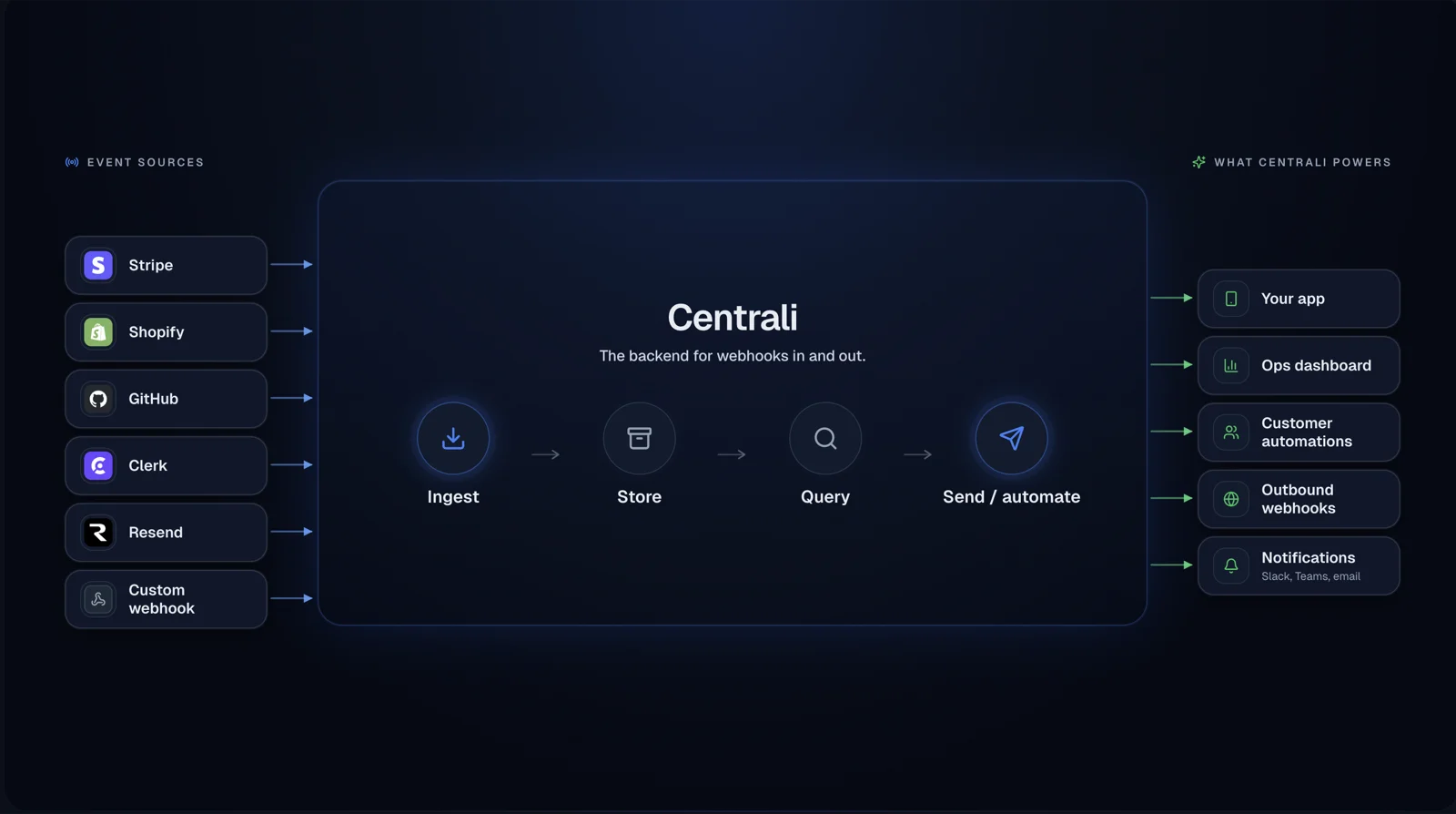
Webhook ingestion
Verify and persist incoming webhooks from any provider.
Store every Stripe event as a record
// Function wired to an HTTP trigger.// Signature verification is configured on the trigger// in the console, so invalid requests never reach this code.async function run() {const event = executionParams.payload;await api.createRecord('stripe-events', {eventId: event.id,eventType: event.type,raw: event,});}
Every third-party system ships its own signature format. Centrali's HTTP trigger validates them all. Verify once, store as a record, process on your schedule.
- Pluggable HMAC validators for Stripe, Svix, and GitHub — configurable algorithm, encoding, and timestamp tolerance.
- Verification happens before your function runs. Invalid signatures never reach your code.
- Accept-and-store pattern: persist the raw payload, process asynchronously via workflows.
Supabase edge functions can handle this flow, but signature verification is still code you write yourself.
Outbound webhooks
Send signed, retried, observable webhooks from the same SDK.
- HMAC-SHA256 signing with rotatable signing secrets.
- Exponential-backoff retries — 30s, 2m, 10m, 30m, max 5 attempts.
- Per-delivery logs with full request, response, status code, and latency.
- Replay failed deliveries or cancel pending retries from SDK, REST, or console.
- Subscribe only to the events or collections you care about.
Emit your own webhooks — order updates, job completions, audit events — without building the infrastructure. Every delivery signed, retried on failure, logged end-to-end, replayable with one click. Same SDK that ingests them.
Subscribe a customer endpoint — one SDK call
import { RecordEvents } from '@centrali-io/centrali-sdk';// Signing, retries, delivery logs, and replay are all handled.const sub = await centrali.webhookSubscriptions.create({name: 'customer-acme-orders',url: 'https://customer-acme.example.com/webhooks',events: [RecordEvents.CREATED, RecordEvents.UPDATED],recordSlugs: ['orders'],});// `sub.data.secret` is returned once on create —// hand it to your customer so they can verify deliveries.console.log('Signing secret:', sub.data.secret);
Built-in signing, retries, replay, and delivery logs from the same SDK. Teams that need customer-facing webhook portals or highly configurable delivery controls can pair Centrali with Svix.
Automations
Chain events into multi-step workflows with decisions, delays, and per-run observability.
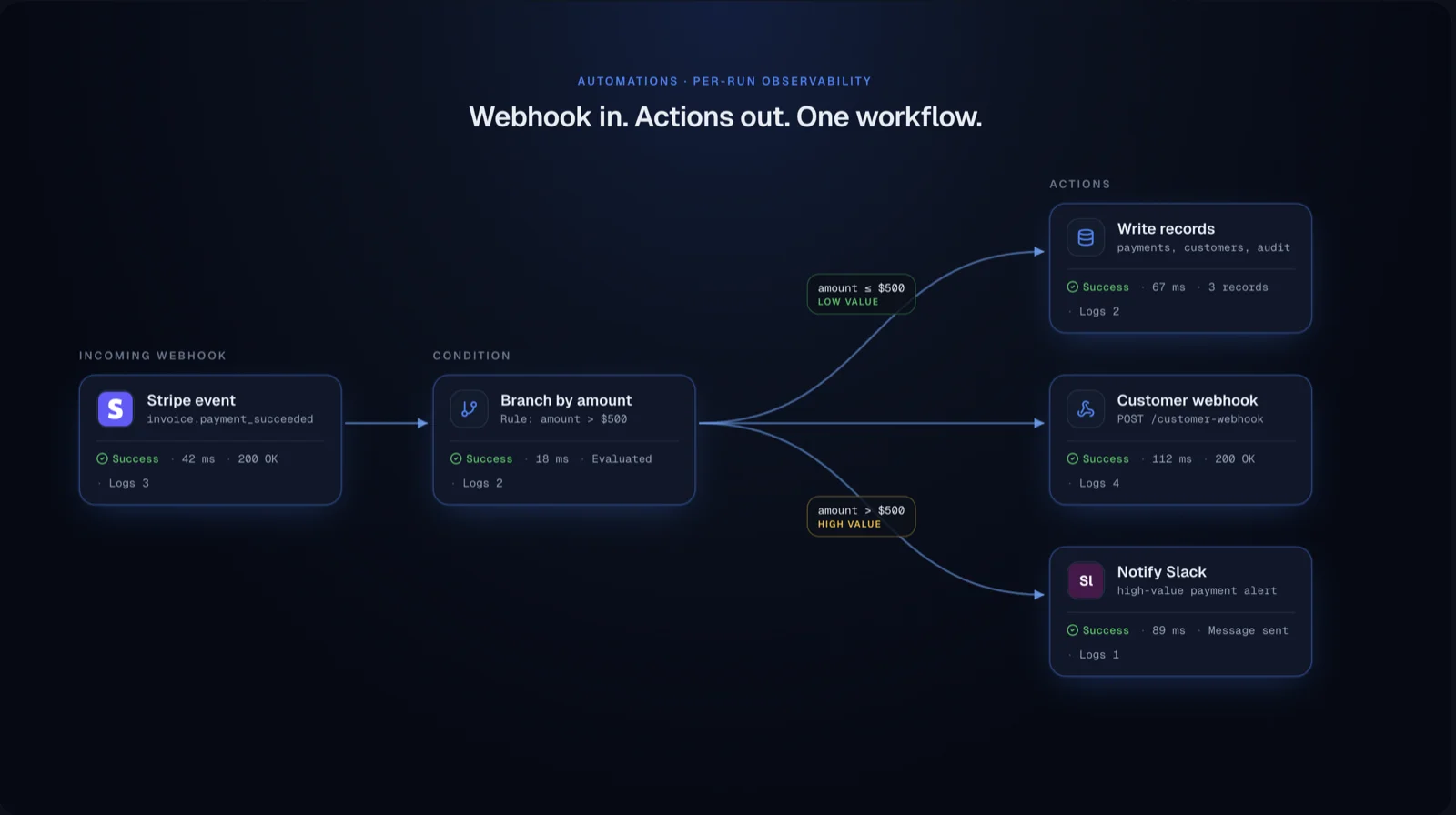
When one event needs more than one step, turn it into a workflow. Decision branches, delay steps, per-run observability. Debug without guessing.
- Multi-step workflows with decision branches (10+ comparison operators) and delay steps.
- Flexible triggers — data events, HTTP webhooks with signature validation, cron schedules, on-demand.
- Step-level input/output, activity logs, and execution traces per run.
- Functions run JavaScript with the Centrali SDK built in — records, crypto, templating, file storage.
Ahead of Supabase and Firebase on native workflow orchestration. Teams with deeply durable, long-running workloads may still want Inngest or Trigger.dev.
Where the event data lives
Typed collections, encrypted secrets, file storage, search.
Every ingested webhook becomes a record. Every record is a typed, queryable, first-class object — the same shape your app data uses. This is where the events live.
- Schema-enforced collections with declarative relationships.
- Secret fields encrypted at rest (AES-256-GCM), masked in API responses.
- Direct-URL file storage tied to the same records — uploads land alongside the event that triggered them.
- Full-text search across ingested event records and your own application records — same backend.
- SDK and REST API parity — every primitive is scriptable.
Bring your own auth
Plug in Clerk, Auth0, Keycloak, Okta, or any OIDC provider.
Centrali doesn't ship an auth product for you to outgrow. Bring the identity provider you already use; claims map to Centrali users and roles, and identity propagates to functions, automations, and per-record access rules.
- First-class OIDC — tested with Clerk, Auth0, Keycloak, and Okta.
- IdP claims map to Centrali users and roles.
- Identity propagates to functions, automations, and data access.
Stop stitching webhook tools, storage, and backend logic together.
Build on the backend for the webhooks you receive.